

Empowering Development | Yuanda Biological Functional Postgenic Element YDFF ®- 3. Support the high-quality development of the pre packaged food industry
 2023-04-28 09:12:21
 Page views: 1989
  Author: 元达生物
2023-04-28 09:12:21
Author: 元达生物
The global demand for convenient food continues to accelerate, especially in the field of pre packaged meals, which has shown enormous market potential
The Central Committee of the Communist Party of China and the State Council recently issued the "Opinions on Doing a Good Job in the Key Work of Comprehensive Rural Revitalization in 2023", which clearly mentioned "improving the standardization and normalization level of industries such as clean vegetables and central kitchens. Cultivating and developing the prefabricated vegetable industry
At present, the pre packaged food industry is experiencing a development trend. According to official data, the size of China's pre packaged food market reached 300 billion yuan in 2021, and 419.6 billion yuan in 2022. It is expected to maintain a high growth rate in the future, and the size of China's pre packaged food market is expected to reach 1072 billion yuan by 2026.
The synergy between B-end operation and C-end demand
Accelerating the flourishing development of the pre packaged food industry together
B-end: The continuous increase in operating costs such as labor and rent, as well as the chain rate (matrix development strategy), is a common challenge faced by catering enterprises. Prefabricated dishes have the advantages of convenient operation and controllable quality, which can help restaurants reduce area costs, reduce excessive dependence on chefs, achieve unified taste of chain store dishes, effectively improve the efficiency and profitability of catering enterprises, and promote the development of the prefabricated food industry.
C-end: With the acceleration of the pace of life, the enhancement of health awareness, and the increase of disposable income, the three major trends of health, environmental protection, and convenience have had a huge and lasting impact on people's diet: the difficulty in controlling the quality of takeaway ingredients, and the tedious process of home cooking, which cannot meet people's requirements for food in fast-paced life. Prefabricated dishes have the characteristics of no cutting, no washing, and no mixing, which are convenient and fast, and meet the needs of modern life. They are deeply loved by many consumers.
At the same time, the pandemic era has further accelerated the development process of pre made dishes.
Challenges and opportunities coexist
There are still hidden dangers in food safety and preservation in the pre packaged food industry
But opportunities always come with various challenges. According to the People's Daily Online's "Caimi Oil and Salt" report, many consumers have complained about safety hazards such as insufficient weight, slow external cold chain transportation, and food spoilage in the pre made dishes they buy.
This means that although pre made dishes have entered the fast lane of development, higher requirements have been put forward for their "health", "safety", and "nutrition" attributes: it is necessary to maintain the original state of the ingredients as much as possible, reduce processing such as heat treatment, and ensure that during food processing, storage, and transportation, the ingredients are protected from spoilage caused by microorganisms. At the same time, it poses great challenges to food processing technology and preservation mechanisms, making food preservation particularly important.
Under certain conditions, the use of preservatives as an auxiliary means of preservation has a significant effect on preventing the spoilage of pre made food ingredients, making preservatives one of the important food additives. According to GB 2760-2014 "Standard for the Use of Food Additives", nearly 40 types of food preservatives have been approved for use, including benzoic acid, sodium benzoate, sorbic acid, potassium sorbate, calcium propionate, etc. The sources of various food preservatives are different and can be divided into two categories: chemical preservatives and natural preservatives. At present, chemical preservatives are the main preservatives commonly used in food. However, the widespread consumption of pre packaged foods, pre made dishes, and other foods has led to the "cumulative intake" of chemical preservatives, which may result in excessive consumption of chemical preservatives. Therefore, there is still potential harm to human health, and it can also lead to a decrease or even disappearance of the nutritional and edible value of food, causing huge economic losses to food enterprises.
Of course, the preservation of pre made vegetables is quietly undergoing changes.
Natural food preservatives are more widely accepted by the pre packaged food industry, related enterprises, and consumers due to their non-toxic, safe, and efficient advantages. Natural preservatives are bound to be the key to the future food market.
At present, there are roughly three types of natural preservatives: plant-based, animal based, and microbial based. With people's increasing awareness of "efficient, safe, non-toxic, and residue free" biological preservatives, market demand continues to grow, and there is gradually a trend of replacing chemical preservatives with biological preservatives.
Tailored solutions
Yuanda Biotech's Postgenic Element YDFF ®- 3 Food Probiotics and Preservatives Experts
Based on the strong demand for "health and safety" in pre packaged food, experts from Yuanda Biotechnology have been committed to the research and development of green bio preservation technology to help the pre packaged food industry achieve the goal of both safety and nutrition. Starting from solving the key problem of green food preservation, Yuanda Biotechnology screened pure milk derived probiotics with high antibacterial activity and prepared YDFF, a post microbial raw material with natural biological preservation effect ®- 3. In addition to excellent anti-corrosion performance, it can also regulate the balance of intestinal microbiota, improve immunity, and assist in the treatment of gastrointestinal diseases, achieving a dual effect of "natural green anti-corrosion" and "functional". It is this natural preservative material that not only brings benefits to C-end consumers, but also promotes the high-quality development of the pre packaged food industry.
Raw material YDFF for secondary generation ®- 3 characteristics: natural, efficient, safe, stable, resistant to high acid and high temperature;
Raw material YDFF for secondary generation ®- 3. Anti corrosion principle: Postbiotics contain various active ingredients such as antimicrobial peptides, short chain fatty acids, organic acids, extracellular polysaccharides, etc. Its mechanism of action is mainly to form micropores on the cell membrane, leading to an increase in cell membrane permeability, inhibiting the formation of pathogenic bacterial biofilms, thereby killing or inhibiting the growth of microorganisms and playing a role in anti-corrosion;
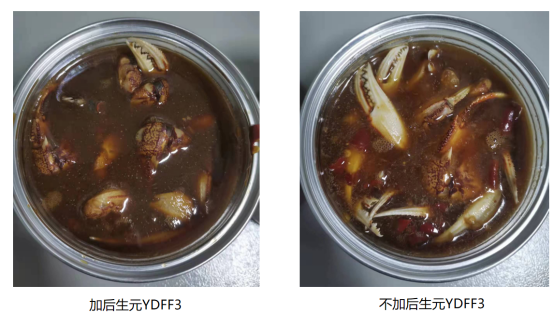
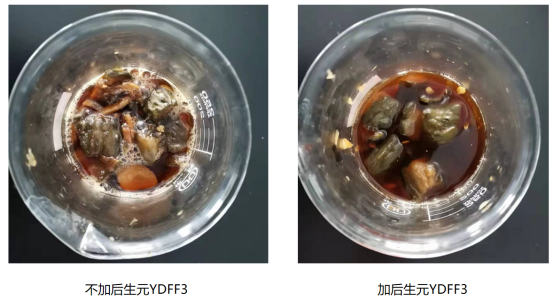
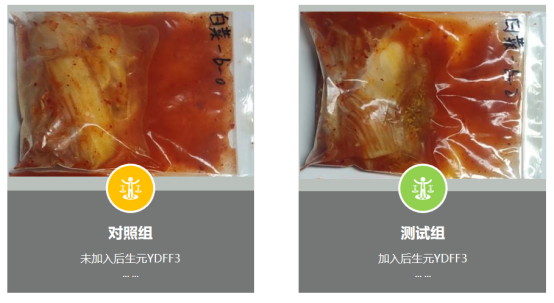
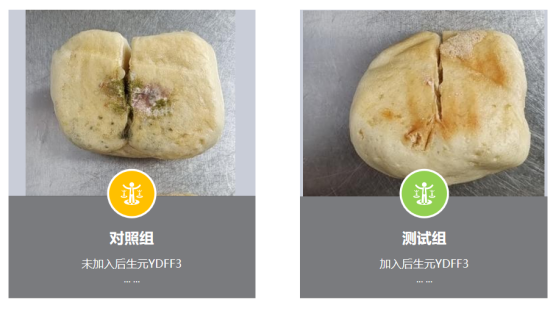
Raw material YDFF for secondary generation ®- 3 application scenarios: It can be added to different types of food such as milk and dairy products, compound seasonings, cooked meat and seafood, pickled vegetables, beverages, baked goods, functional health products, etc., and has a wide range of applications.

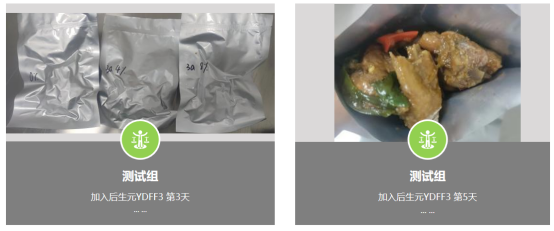
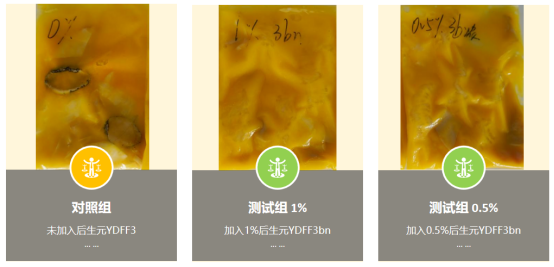
Raw material YDFF for secondary generation ®- 3 Food Preservation Cases:
Top level technological strength
Yuanda Biotechnology has a strong research institution endorsement
Raw material YDFF for secondary generation ®- 3 has been put into the market, and its excellent natural biological anti-corrosion solution continues to empower the development, transformation, and upgrading of the food anti-corrosion field. All of this is attributed to the strong scientific research capabilities of Yuanda Biotechnology. As a key enterprise supported by the government, Yuanda Biology has always adhered to the principle that "scientific research and innovation are the core competitiveness of enterprises" since its inception. The company has built GMP fermentation workshops, research and development laboratories, testing laboratories, etc. It has built the only target functional metabiotic strain resource pool in China, has more than 120 metabiotic processes and formulas, and has worked closely with famous scientific research institutes at home and abroad, such as Copenhagen University, Xiamen University, Chinese Academy of Sciences, Shandong University, Northwest A&F University of Science and Technology, Inner Mongolia Agricultural University, the key laboratory of the Ministry of Agriculture of the Ministry of Dairy Science and Technology Education, etc. It has done a lot of in-depth research around the metabiotic industry, worked as the main drafting unit to develop the first metabiotic group standard in China, and also sponsored the first China Science and Technology Conference of Later Generation.
Yuanda Biotechnology has led or participated in more than 10 national and provincial level research projects in related fields, and has published over 40 high-level papers in SCI TOP journals, SCI, and EI. So far, it has authorized more than 10 patents and won 7 awards at or above the provincial and ministerial level. Its scientific and technological achievements have been rated as "international leading" level, and many authoritative certifications have empowered Yuanda Biotechnology to embark on a new journey of international layout.
In the future, Yuanda Biotechnology will continue to adhere to the company's development philosophy, and provide professional terminal product solutions for enterprises through the research and development of high-performance next-generation products, helping enterprises achieve high-quality development.
-
 Previous :Quality pre made meals, healthy new consumption | The 2nd China International Pre made Food Industry Development Conference grandly opened in Qingdao!
 -
Next :Good news | Professor Peng Chuantao has been awarded the Outstanding Contribution Award for High Quality Development of Qingdao Agricultural University in 2025
 Related News

-
青岛市领导调研元达生物
 2026-07-13
 -
科技部部长阴和俊视察上合组织科创中心
2026-07-13
-
元达生物后生元Postbiocare缓解急性酒精性肝损伤研究成果登上国际著名食品期刊
2026-04-22
-
喜报 | 彭传涛教授荣获 2025 年青岛农业大学高质量发展突出贡献奖
2026-03-30
-
2026 FIC | 元达生物惊艳亮相!靶向功能性后生元引领健康新风向
2026-03-20